
Rising Costs, Smart Moves: What Recent Price Increases Mean for Your Business
If you're in construction, trades, or any business that relies on materials and freight, you've probably already seen supplier prices climbing. The conflict in the Middle East is accelerating it.
Let’s talk about what's happening, how it might affect you, and what you can do about it.
What's Happening
You may have already seen the letter from Reece (Australia's largest plumbing and bathroom supplier, with over 600 outlets) announcing price increases of between 28.5% and 36% on plastic pipes and fittings, taking effect from next month. The increases are directly linked to the conflict in Iran, which has disrupted global oil and resin supply.
As Reece put it in their letter to customers: the industry is "suffering from a lack of supply of raw material, fuel and freight options, which is driving costs upwards, adding immense pressures". But Reece aren't alone. The AFR has reported that steel manufacturers are raising prices by 15–25%, timber group Big River is adding surcharges of 10–15%, and the price of resin, often imported from the Middle East and Asia, has jumped as much as 50% before freight is added.
This is the same pattern we saw during the pandemic in 2020, when higher prices and supply problems led to budget blowouts on major projects. The NSW Master Plumbers Association has estimated that pipe price rises alone will add $600 in materials costs on a standard four-bedroom house.

Up to 36%
Reece's announced increase on plastic pipes, with steel up 15-25%, timber up 10-15%, and resin costs up 50%
And these increases are landing all at once.
⚠ Plastic Pipes & PVC - Up 28.5–36%
Reece (600+ outlets nationally) has written to customers confirming increases of 28.5-36% on plastic pipes from next month. Mitre 10 (380 outlets) has also been notified by its plastic pipe supplier of a price increase. The driver: resin prices have jumped up to 50%, before freight is added. Viva Energy is now Australia's only domestic producer of polypropylene.
⚠ Steel - Up 15–25%
Steel manufacturers are raising prices on some products by 15-25% (AFR, this week). Higher energy costs and global supply chain disruptions are flowing through to structural steel, reinforcement, and fittings used across residential and commercial construction.
★ Timber & Engineered Wood - Up 10–15%
ASX-listed Big River (26 outlets) has announced surcharges of 10-15% after fuel prices doubled. Particleboard and plywood are under particular pressure because manufacturing requires urea (a petrochemical derivative now in short supply). CEO John Lorente noted: "there aren't any shortages" yet, but "everyone in the industry is watching things carefully."
★ Fuel & Freight
The Iran conflict has restricted oil shipments through the Strait of Hormuz, pushing fuel prices sharply higher. Big River cited a doubling in fuel costs as the direct trigger for its surcharges. Mitre 10 confirmed that hardware suppliers are flagging intended price increases due to higher fuel-linked freight costs. Any business reliant on vehicles, deliveries, or logistics will feel this.
● Flow-On Effects: Insurance, Energy & Food
Beyond direct material costs, expect ripple effects. Business insurance premiums (especially trade and construction) continue climbing. Wholesale energy prices are rising on global uncertainty. Food and hospitality supply chains face higher transport and packaging costs. Mitre 10 noted suppliers across hardware categories are indicating price increases, not just pipes.
Who's Most Affected
Not every business will feel these increases equally. The impact depends on your industry, how much of your cost base is tied to materials and fuel, and whether you're able to pass costs on to your customers. Here's a quick guide:
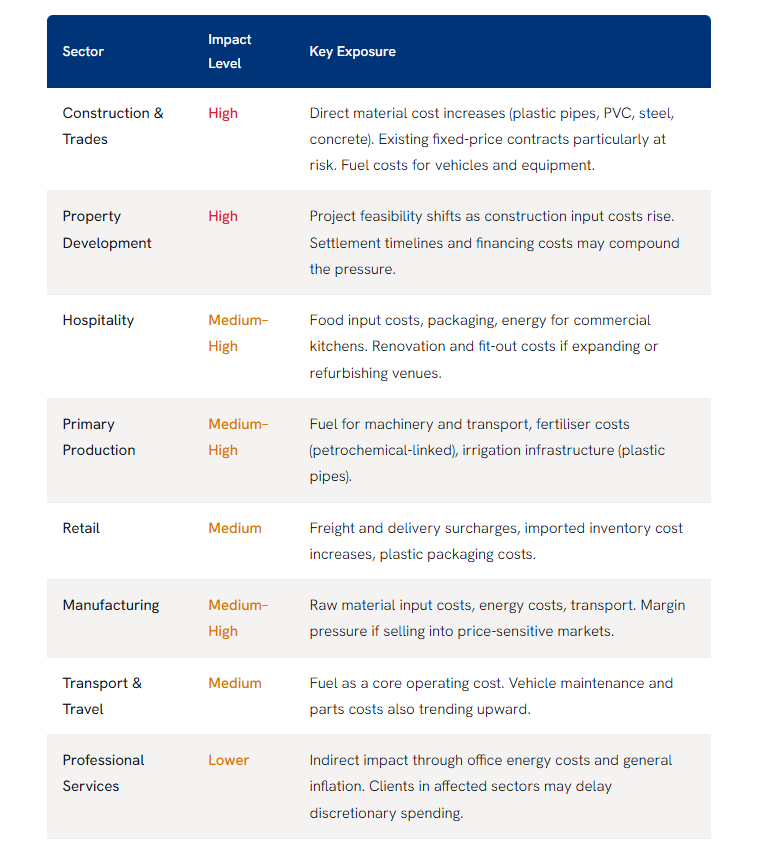
What You Can Do: Six Practical Strategies for Business Owners
Price increases don't have to mean lower profits. The businesses that come through periods like this strongest are the ones that act early, stay informed, and make strategic decisions. Here's where to start:
1. Review and Adjust Your Pricing (Now, Not Later)
If your own costs are rising, your prices need to reflect that. The NSW Master Plumbers Association estimates that pipe price rises alone add $600 in materials to a standard four-bedroom house… and that's before steel and timber increases are factored in. Review your current pricing against updated costs and build in a margin of safety. For trades and construction businesses on fixed-price contracts, consider adding rise-and-fall clauses to all new quotes. Don't wait until margins have already been eroded.
2. Stress-Test Your Cash Flow
Higher costs mean more cash going out the door before revenue catches up. Run a 13-week cash flow forecast with updated cost assumptions (we can help with this if you need). Identify the pinch points. If you're going to need a short-term facility or need to adjust payment terms with suppliers, it's better to arrange that now while you have options… not when you're under pressure.
3. Lock In Supplier Pricing Where You Can
If you have strong supplier relationships, now is the time to negotiate forward pricing or bulk-purchase commitments on key materials before the next round of increases. Some suppliers will offer price locks in exchange for volume or early payment. Even a 60-90 day hold can make a meaningful difference to project margins.
4. Review Your Contracts and Quoting Process
As the NSW Master Plumbers Association noted, "a lot of these jobs have been quoted months ago." Fixed-price contracts signed before this round of increases are the biggest risk area - plumbers in particular are "already on razor-thin margins."
For new work, build in escalation clauses that link material costs to an index or allow for adjustment on projects longer than 90 days.
Review your quoting assumptions and make sure your estimating team is working with current costs, not last quarter's.
5. Explore Tax Planning and Timing Opportunities
With the end of the financial year coming up, there may be opportunities to bring forward deductible purchases (especially materials or equipment you'll need anyway) to maximise deductions in FY2026. The instant asset write-off and other concessions may help offset the cost impact. Talk to us, we can model the best timing for your situation.
6. Communicate With Your Customers
If you need to pass on cost increases, do it transparently. It's natural to worry about losing customers when you raise prices. But when every supplier in the chain is doing the same thing, your customers are already expecting it. The businesses that communicate it well actually build trust through the process.
In our experience, customers respond better to honest, clear communication than to surprise price jumps. A short note explaining that supplier costs have increased due to global factors (and what you're doing to minimise the impact) goes a long way. We can help you draft something if that would be useful.
Let's Talk About Your Situation
Every business is different, and the right response depends on your specific cost structure, contracts, and cash position. If you'd like to work through any of these strategies together, whether that's a cash flow stress-test, a pricing review, or year-end tax planning, we're here to help.